How to Build Self-Learning AI Agents
A practical guide to AI agent architecture — tools, memory, planning, feedback loops, and evaluation — with code examples and honest distinctions between self-learning and self-improving systems.

The Chatbot Mirage and the Reality of Agency
There is a widespread misconception that if you take a large language model, bolt on a nice user interface, and give it a system prompt telling it to act like a helpful assistant, you have built an AI agent. You haven't. You have built a chatbot.
A chatbot is reactive. It waits for you to say something, predicts the most statistically probable sequence of tokens to follow your prompt, and then goes back to sleep. It has no goals, no persistence, and no ability to affect the world outside its chat window. If you ask a chatbot to book you a flight, it will confidently output the text of a confirmation email, but you will still be sitting on your couch on Tuesday.
An AI agent, on the other hand, is active. It is a software system that uses a language model as its reasoning engine to autonomously plan, use tools, interact with external environments, and work toward a defined objective over multiple steps. An agent doesn't just generate text; it generates actions.
The distinction between a language model and an agent is exactly the difference between a brain in a jar and a person with hands. The brain might be brilliant, but it can't turn the page of a book. Agentic AI is about giving the model hands.
In my work as a consultant here in Bangladesh, I spend a lot of time un-confusing clients about this. They see the hype around "autonomous AI" and assume the models themselves have suddenly become sentient go-getters. In reality, building an agent is an engineering problem. It is about wrapping the model in a scaffolding of memory, planning frameworks, and API integrations that allow it to execute complex workflows.
The Architecture of Autonomy
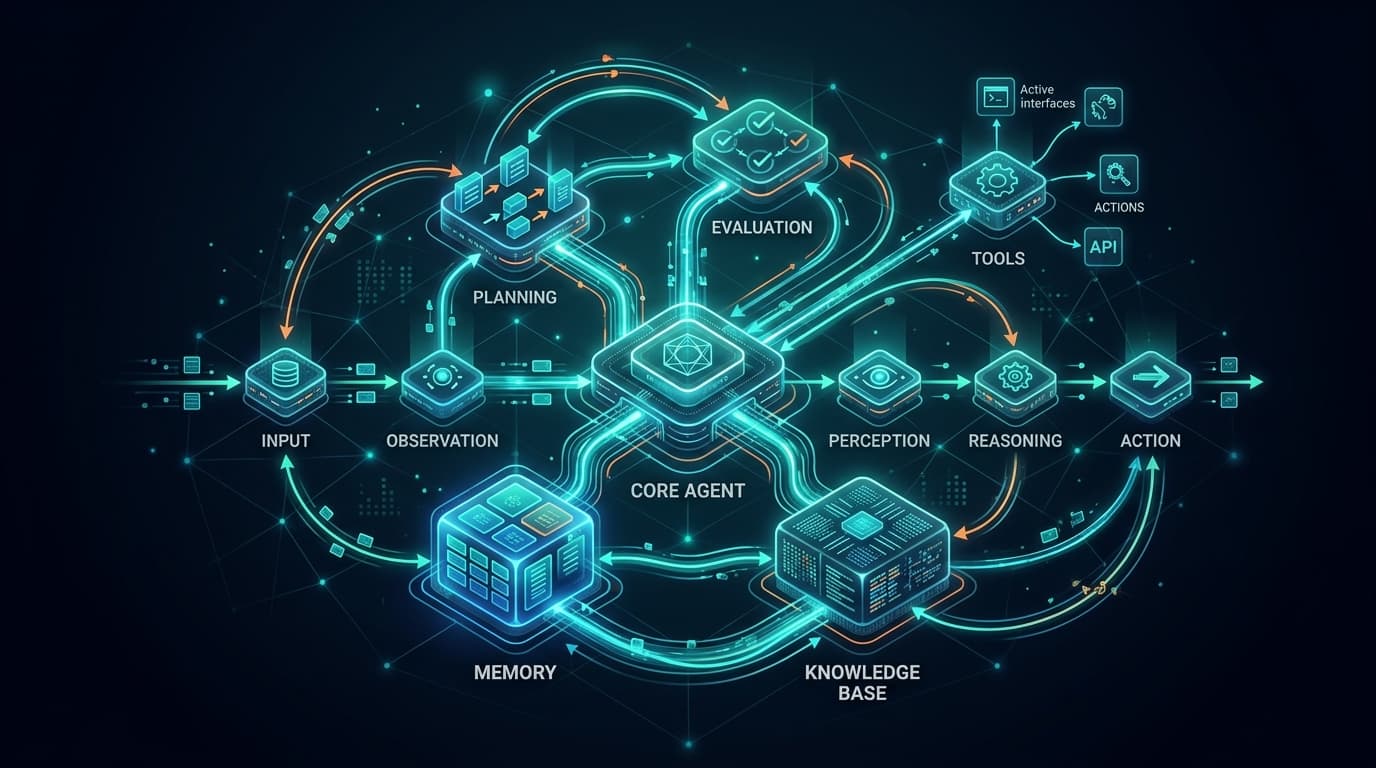
Before we look at code, we need to understand the structural components of an agent. If the LLM is the reasoning engine, the agentic framework is the chassis. A functional agent requires four core pillars:
- Planning: The ability to break down a complex, ambiguous goal into a sequence of actionable steps. This includes formulating a strategy, evaluating alternatives, and adapting the plan when things inevitably go wrong.
- Memory: Both short-term (maintaining context within a single execution loop) and long-term (recalling past interactions, user preferences, or environmental facts across sessions).
- Tool Use (Actuation): The mechanisms by which the agent interacts with the outside world. This could be searching the web, executing code, querying a database, or calling external APIs (like actually booking that flight).
- Evaluation and Feedback Loops: The capacity to assess the outcome of an action against the intended goal, identify errors, and self-correct. This is the "self-learning" part, and it is arguably the hardest piece to get right.
Let's visualize this conceptually. Imagine the flow of information through an agentic system:
Input / Goal → The user provides an objective.
Memory / Retrieval → The agent pulls relevant context from its database.
Reasoning / Planning → The LLM decides what to do next based on the goal and context.
Tool Selection → The LLM formats a request to use a specific function.
Action Execution → The Python runtime executes the function and gets a result.
Evaluation → The LLM reviews the result. Did it work? Did it fail?
Feedback → If it failed, the error becomes new context. Return to Reasoning.
Output / Completion → If successful, finalize the task.
Notice that this is a loop, not a straight line. The model isn't just taking an input and emitting an output; it is engaging in a continuous dialogue with the tools and the environment.
The "Self-Learning" Misconception
We need to address the phrase "self-learning." When non-engineers hear this, they usually assume the AI is rewriting its own neural pathways on the fly—adjusting its weights and biases in real-time as it interacts with the world.
That is not what is happening. Continuous fine-tuning in production is incredibly expensive, highly unstable, and prone to catastrophic forgetting (where learning a new task causes the model to forget how to do an old one). We do not let models retrain themselves in real-time.
When we talk about "self-learning" agents, we are talking about in-context learning and memory-driven feedback loops. The model's fundamental weights remain frozen. Instead, the agent "learns" by accumulating successful strategies and past failures in its long-term memory (usually a vector database). Before the agent takes an action, it retrieves this historical context and injects it into its prompt.
It's the difference between altering your brain chemistry (changing weights) and writing a note in your journal so you don't make the same mistake tomorrow (in-context memory). The latter is how we build self-improving systems today.
Memory and Retrieval-Augmented Generation (RAG)
For an agent to be useful, it needs to know things that aren't in its training data. This is where Retrieval-Augmented Generation (RAG) comes in. RAG is essentially giving the agent a searchable reference library.
When an agent needs information, it doesn't just guess. It takes the user's query, converts it into a mathematical representation called an embedding, and searches a vector database for similar embeddings. It then retrieves the raw text of those documents and pastes them into its working memory (the prompt) before generating an answer.
In an agentic workflow, RAG is just another tool. A typical chatbot performs RAG once per message. An agent might perform RAG multiple times autonomously while trying to solve a problem. For example, if tasked with writing a report on a company, it might search the database for financial records, realize it's missing Q3 data, autonomously formulate a new query specifically for Q3, retrieve that, and only then begin writing.
Reasoning Frameworks: ReAct and Chain-of-Thought
How do we actually force a language model to think before it acts? We use prompting frameworks that constrain its output into a structured format.
The foundation of this is Chain-of-Thought (CoT) prompting, where we explicitly tell the model to "think step-by-step." By forcing the model to generate the intermediate reasoning steps before generating the final answer, we give it computational space to work through the logic.
In agent design, we extend this into the ReAct (Reasoning and Acting) pattern. ReAct forces the model into a strict loop of Thought, Action, and Observation.
It looks like this:
Thought: I need to find the current weather in Dhaka to answer the user's question.
Action: get_weather
Action Input: {"location": "Dhaka, Bangladesh"}
Observation: The weather is 32°C and humid.
Thought: Now I have the weather. I can formulate my final response.
Final Answer: It's currently 32°C and humid in Dhaka.
The "Thought" and "Action" are generated by the LLM. The framework then halts the LLM, parses the "Action", runs the actual Python code to check the weather API, and feeds the result back to the LLM as the "Observation".
Building a Simple Agent: Let's Write Some Code
To demystify this, let's look at how you actually code a basic tool-calling agent in Python. We will avoid bloated frameworks and look at the raw logic.
First, we define our tools. These are just regular Python functions, but we must provide clear docstrings so the LLM knows when and how to use them.
def get_weather(location: str) -> str:
    """Returns the current weather for a given location."""
    # In reality, you'd call a weather API here
    return f"It is sunny and 30C in {location}."

def calculate_math(expression: str) -> str:
    """Evaluates a mathematical expression safely."""
    # Never use raw eval() in production, use a safe parser
    return str(eval(expression))

# A dictionary mapping tool names to the actual functions
TOOLS = {
    "get_weather": get_weather,
    "calculate_math": calculate_math
}
Next, we need the execution loop. The agent needs to prompt the LLM, check if the LLM wants to use a tool, run the tool, and pass the result back.
import json
import openai

def run_agent(user_query: str, max_iterations=5):
    system_prompt = """
    You are a helpful assistant. You have access to the following tools:
    1. get_weather(location: str)
    2. calculate_math(expression: str)

    If you need to use a tool, output a JSON block exactly like this:
    {"tool": "tool_name", "args": {"arg1": "value"}}

    If you have the final answer, output a JSON block exactly like this:
    {"final_answer": "Your detailed answer here"}
    """

    messages = [
        {"role": "system", "content": system_prompt},
        {"role": "user", "content": user_query}
    ]

    for i in range(max_iterations):
        # 1. Call the LLM
        response = openai.ChatCompletion.create(
            model="gpt-4",
            messages=messages
        )
        llm_output = response.choices[0].message.content

        # 2. Add the LLM's thought to the context history
        messages.append({"role": "assistant", "content": llm_output})

        try:
            # Parse the LLM's intent
            parsed = json.loads(llm_output)

            # 3. Check for final answer
            if "final_answer" in parsed:
                return parsed["final_answer"]

            # 4. Execute tool
            if "tool" in parsed:
                tool_name = parsed["tool"]
                args = parsed["args"]

                if tool_name in TOOLS:
                    print(f"Agent executing: {tool_name} with {args}")
                    tool_result = TOOLS[tool_name](**args)
                else:
                    tool_result = f"Error: Tool {tool_name} not found."

                # 5. Feed the observation back to the LLM
                observation = f"Tool result: {tool_result}"
                messages.append({"role": "user", "content": observation})

        except json.JSONDecodeError:
            # If the LLM didn't output valid JSON, tell it to fix it
            messages.append({"role": "user", "content": "Error: Please output valid JSON as instructed."})

    return "Agent failed to complete task within max iterations."
This simple script demonstrates the entire concept of autonomy. The while loop (or for loop in this case) is the heartbeat of the agent. It will keep thinking and acting until it reaches its goal or hits the iteration limit.
Evaluation, Feedback, and Self-Correction
The code above has a primitive feedback loop built in. If the LLM generates invalid JSON, the except block catches it and feeds the error back to the LLM. Modern models like GPT-4 or Claude 3.5 Sonnet are excellent at seeing an error like "JSONDecodeError" and adjusting their next output to fix the formatting.
But self-correction goes much deeper. In advanced agents, we implement critic models. Instead of a single LLM trying to do everything, you have an Actor model generating code or actions, and a Critic model evaluating the result.
For example, if the Actor writes a Python script to analyze data, the framework actually runs the script. If the script throws a traceback, the framework passes the traceback to the Critic. The Critic analyzes why the script failed, writes a detailed explanation of the logic error, and passes it back to the Actor to try again.
This iterative loop—Actor drafts, runtime executes, Critic reviews—is how "self-learning" actually manifests in production. The system learns how to solve the specific task at hand through trial and error, guided by a rigorous evaluation protocol.
Guardrails, Pitfalls, and How It All Breaks
Building agents looks easy in toy examples, but it is brutally difficult in production. When you give a non-deterministic statistical model an infinite loop and access to APIs, things go wrong in spectacular ways.
1. Infinite Loops and Spirals of Doom
Agents are prone to getting stuck. An agent might call an API, get an unexpected error, try the exact same call again, get the same error, and loop infinitely until it drains your OpenAI API budget. You must implement hard limits on iterations (like the max_iterations in my code) and implement logic that forces the agent to try a different tool if the first one fails three times.
2. Hallucinated Tool Calls
Sometimes, an LLM will just invent a tool that doesn't exist. It might output {"tool": "hack_mainframe", "args": {}}. Your system needs robust error handling to catch unsupported tool requests and politely inform the LLM that it cannot do that.
3. The Context Window Collapse
As the agent loops through Thoughts, Actions, and Observations, the conversation history grows. Eventually, it will exceed the LLM's context window. Even if it doesn't, LLMs suffer from "lost in the middle" syndrome, where they forget instructions at the beginning of a very long prompt. You have to implement state management—summarizing past actions, pruning old observations, and keeping the working memory tight and relevant.
4. Security and Sandboxing
Never give an agent unsupervised access to critical systems. If an agent has a tool that can execute shell commands, you are one prompt-injection attack away from having your entire server deleted. Agent execution environments must be heavily sandboxed, using Docker containers or virtual machines, with strictly scoped API keys (least privilege access).
The Future of Agentic Workflows
We are transitioning from a world where AI is a tool we use, to a world where AI is a worker we manage. The next generation of software won't just be applications you click through; they will be autonomous systems operating in the background, collaborating with each other, handling complex, multi-step workflows on our behalf.
But getting there requires rigorous engineering. It requires understanding that the language model is just the CPU. The real magic of building AI agents lies in how you design the motherboard: the memory systems, the feedback loops, and the guardrails that turn a text generator into an autonomous problem solver.